
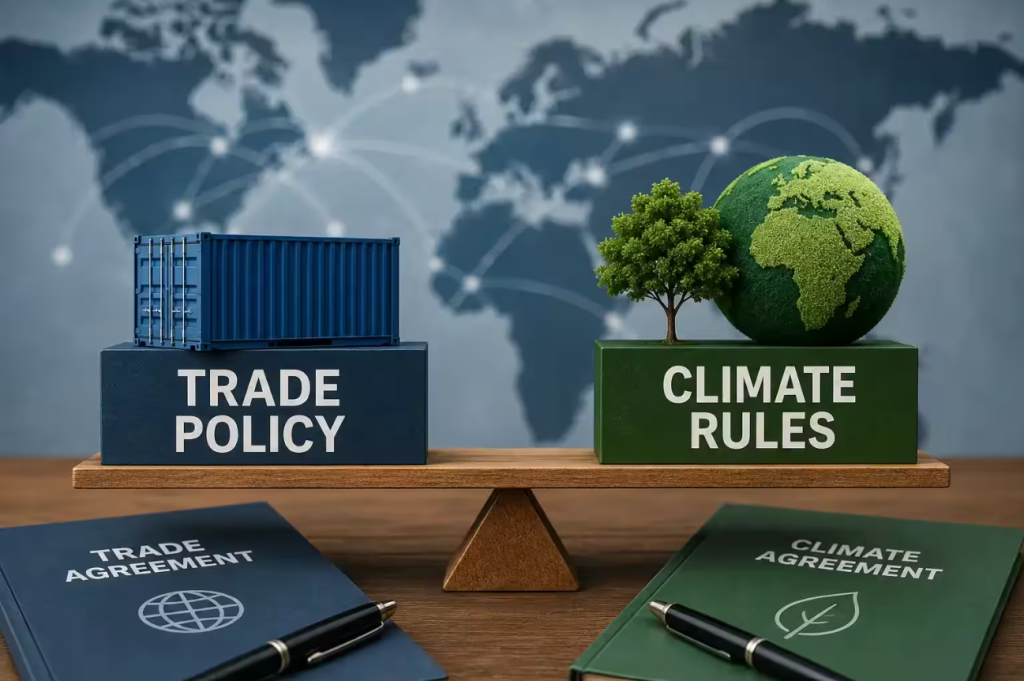
India has begun consultations to frame its response to climate-linked trade rules that are reshaping access to global markets. The Commerce Ministry is weighing domestic carbon systems, certification tools and negotiation strategy as sustainability becomes central to FTAs and border measures. The move reflects a broader shift in which exporters must prepare for carbon taxes, deforestation norms and new disclosure demands from key markets such as the European Union and the US.
India is moving to treat climate compliance as a trade issue, not just an environmental one. With carbon taxes, deforestation rules and sustainability clauses increasingly embedded in global commerce, New Delhi has begun a formal consultation process to decide how exporters should adapt and how trade policy should respond.
The first step in that exercise took place in the capital this week, where officials and stakeholders gathered at Vanijya Bhawan for a workshop on Trade and Sustainable Development. According to CNBC TV18, the meeting marked the start of a wider series of discussions aimed at building India’s position on a fast-changing policy agenda that is now influencing market access, supply chains and negotiating leverage in free trade agreements.
What once sat largely in the domain of environmental policy is now being written into the rules of cross-border commerce. The European Union’s Carbon Border Adjustment Mechanism, the European Union Deforestation Regulation and trade measures under the US Trade Act are among the frameworks forcing exporters to prove that their products meet stricter sustainability expectations.
The Department of Commerce has launched a series of workshops to shape India’s Trade and Sustainable Development approach, with the first session held on Friday in New Delhi. The ministry said the discussions were designed to examine how India should respond to sustainability-linked trade rules and how domestic policy tools can be better aligned with global expectations.
Commerce Secretary Rajesh Agrawal told the workshop that Trade and Sustainable Development is no longer a niche policy subject. He described it as a cross-sectoral issue that requires coordination across trade, industry, sustainability and competitiveness. His remarks reflected a broader official view that environmental standards are becoming a permanent feature of the global trading system rather than a temporary policy experiment.
Agrawal also argued that India needs an enabling ecosystem that allows businesses to adopt cleaner and more traceable practices at scale. Early adaptation, he said, would strengthen the position of Indian exporters and improve readiness for a trade environment in which sustainability credentials carry growing commercial value.
One reason the government is holding these consultations is that India already has several policy instruments that could be used to support a more climate-conscious export strategy. The workshop reviewed the Carbon Credit Trading Scheme, the proposed Indian Carbon Market, the Extended Producer Responsibility framework and the country’s accreditation and conformity assessment infrastructure.
These mechanisms matter because global buyers and regulators increasingly want proof, not promises. A domestic carbon market can help firms price emissions more transparently. Extended Producer Responsibility can push industry towards better waste management and circularity. Accreditation and conformity systems, meanwhile, can improve the credibility of certificates and testing results that exporters present to overseas regulators and customers.
What exporters should watch next
For Indian exporters, the immediate message is that climate policy can no longer be treated as a distant Brussels or Washington issue. The rules being drafted abroad are increasingly tied to product design, sourcing, emissions measurement and disclosure practices at home. Firms that rely on low-margin, high-volume exports may be especially vulnerable if they are slow to document compliance or upgrade processes.
The consultations launched by the Commerce Ministry suggest that the government is beginning to think beyond reactive diplomacy. Instead of responding only when a new rule takes effect, India appears to be building a more systematic trade strategy around sustainability, one that combines domestic reform, industry engagement and negotiation readiness.
That approach may prove important as more economies link market access to carbon intensity, forest protection and supply chain transparency. For India, the real task is to ensure that sustainability requirements do not become a hidden tariff on its exports, while still positioning domestic industry to compete in a world where green compliance is becoming part of the cost of doing business.
As CNBC TV18 reported, the consultation process is only beginning. But the direction is clear: climate rules are moving from the margins of trade policy to its centre, and Indian exporters will need to adjust accordingly.