
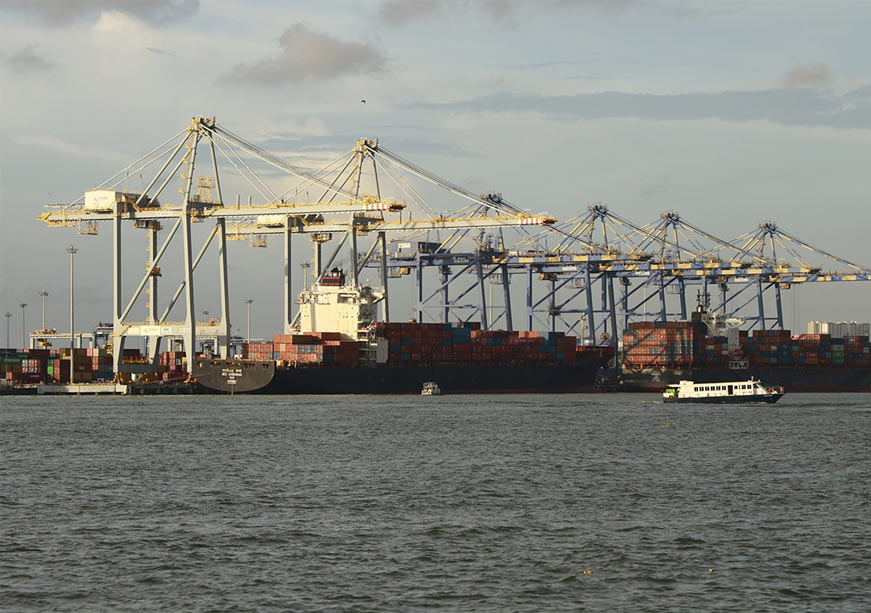
Harit Sagar outlines India’s push to green ports while linking climate action with maritime growth and trade
More than 90 percent of global trade moves by sea, with shipping alone accounting for nearly 3 percent of global greenhouse gas (GHG) emissions. With the International Maritime Organization (IMO) setting a net-zero target for the shipping sector, maritime nations are reassessing how economic growth and sustainability can be pursued in tandem. For developing economies like India, which rely heavily on maritime trade, port networks, and coastal livelihoods, this transition is challenging.
Harit Sagar outlines the pathway for India’s major ports to enhance energy efficiency and climate resilience aligned to international standards.
Indian ports handle almost 95 percent of trade by volume and 70 percent by value, making them critical actors in climate action. India launched the Harit Sagar Green Port Guidelines in 2023 to make its blue economy sustainable, aligning port development with its Nationally Determined Contribution and the Panchamrit goals, which outline five climate commitments. As part of Maritime Amrit Kaal Vision 2047 and Maritime India Vision 2030, Harit Sagar outlines the pathway for India’s major ports to enhance energy efficiency and climate resilience aligned to international standards. It aims to integrate climate ambition with development and trade, offering a template for other developing economies.
Global Net-Zero Shipping and Emerging Economy Limits
IMO’s revised GHG Strategy (2023) sets milestones for cutting emissions from international shipping “by or around 2050,” signalling a net-zero transition by mid-century. It calls for at least a 20-percent reduction, aiming for 30 percent, by 2030, and at least a 70-percent reduction, aiming for 80 percent, by 2040, compared to 2008 levels. In response, Singapore’s Maritime and Port Authority is targeting a 60–percent reduction in its total port emissions by 2030, while introducing ammonia bunkering to scale alternative fuel use. Additionally, the Rotterdam-Singapore Green and Digital Shipping Corridor ensures that international partnerships cut emissions on the major trade route by 20-30 percent by 2030.
Emerging economies and Small Island Developing States (SIDS) face significant constraints, including limited access to finance, structural issues, technological challenges, capacity gaps, and infrastructure readiness,
Unlike Singapore, however, emerging economies and Small Island Developing States (SIDS) face significant constraints, including limited access to finance, structural issues, technological challenges, capacity gaps, and infrastructure readiness, which limit their ability to meet the IMO’s targets. In such countries, smaller ports are often overlooked in the pursuit of larger maritime objectives, while their older fleets risk becoming obsolete. Moreover, new rules on fuels and efficiency could impact the already strained trade routes. Despite their potential to adopt alternative fuels more rapidly than developed economies, the evolving regulatory ecosystem for safety and bunkering could inhibit their progress. Additionally, most green hydrogen and methanol projects, still at the pilot stage, may take longer to scale up.
India, with its national ambitions, its role on the IMO Council, and its focus on strengthening maritime presence, has an opportunity to offer solutions rooted in local realities through its green port framework. However, to achieve this, India’s Harit Sagar efforts will have to move beyond being mere guidelinesby ensuring investments in sustainable port practices, supporting coastal communities, and encouraging green innovation. Such a transformation will require accounting for local trade, population, and environmental needs, as well as overcoming the coordination challengesamong ministries, port authorities, state governments, and private operators, which can delay on-the-ground action.
Harit Sagar’s whole-of-port approach accounts for all activities that contribute to a port’s carbon footprint, including cargo handling and storage, ship operations, logistics services, and hinterland connectivity.
India’s Framework for Climate-Resilient Port Growth
Harit Sagar’s whole-of-port approach accounts for all activities that contribute to a port’s carbon footprint, including cargo handling and storage, ship operations, logistics services, and hinterland connectivity. The framework follows an ‘Eliminate, Reduce, and Control’ model, guiding ports in their everyday decisions towards carbon-neutral development without adversely impacting nearby marine ecosystems and coastal communities.
● Clean Energy Transition and Circular Economy
Harit Sagar encourages ports to adopt cleaner operations through solar and wind energy, equipment and vehicle retrofitting, electrification, and shore power for berthed ships. Ports must reduce carbon emissions by 30 percent per tonne of cargo by 2030 and 70 percent by 2047, while increasing renewable energy use. They are also expected to phase in shore-to-ship power, reuse all wastewater, and reduce freshwater use by over 20 percent by 2030. New Mangalore Port, which now operates entirely on solar power, is a strong example of these initiatives. The framework also focuses on efficient resource use by encouraging ports to streamline operations, reduce ‘idle’ time, and adopt energy-efficient technologies to lower carbon intensity. Additionally, the framework supports circular economy practices, such as efficient waste management, the reuse of dredged material, and waste-to-wealth initiatives, to help ports move towards zero waste while creating economic value.
● Scaling Renewable Energy Across Indian Ports
Harit Sagar prepares ports for future fuels, including green hydrogen, green ammonia, and green methanol, aligned with India’s National Green Hydrogen Mission. Ports are expected to increase renewable energy use to over 60 percent by 2030 and 90 percent by 2047. They must also upgrade infrastructure with specific targets to support offshore wind energy, LNG bunkering and EV charging, while promoting coastal shipping. For instance, Deendayal Port is planning 20 MW of solar and wind capacity; Visakhapatnam has 10 MW of solar; V.O.Chidambaranar Port (VOC) and New Mangalore are expanding their renewable installations. VOC has launched India’s first green hydrogen pilot for streetlights and EV charging, and is planning a green methanol bunkering facility. Ports are also implementing LED lighting upgrades, green building, electrified rail links, and plans for shore power to improve resource efficiency.
● Managing Water, Pollution, and Biodiversity at Ports
The framework considers ports as integral to the coastline and the nearby communities. It focuses on conserving shoreline and mangroves, mitigating air and noise pollution, using water efficiently, managing waste, bilge, and ballast water responsibly, and minimising the impact of dredging. It also considers recharging groundwater as a carbon sink, desalination, and rainwater harvesting. They set clear targets, including reducing freshwater use per tonne of cargo by over 20 percent by 2030, recycling or reusing all wastewater, and increasing green cover by more than 20 percent to strengthen biodiversity and coastal protection.
● Building Climate-Resilient Port Infrastructure
Harit Sagar emphasises the need for ports to prepare for climate risks by regularly assessing local vulnerabilities, strengthening infrastructure, and planning for challenges such as sea-level rise, cyclones, flooding, and coastal erosion. This approach acknowledges that ports must continue to function safely and reliably even as climate impacts increase, while aligning with international objectives. Mormugao Port in Goa, for instance, has been recognised as India’s first green port under Harit Shrey—a green incentive scheme for vessels. The port is listed on the global Environmental Ship Index as a model for promoting cleaner shipping and more sustainable practices across India’s port operations.
● Governance and Transparency in Green Port Systems
The parameters emphasise regular monitoring and reporting of port operations to prevent greenwashing and ensure compliance. Ports have to track progress under the Environment Management Guidelines and Environmental Performance Indicators, gradually adopting frameworks such as the Global Reporting Initiative, within 6 to 18 months. Impact assessments and annual audits guide ports toward achieving targeted environmental, economic, and social goals. Harit Sagar encourages earning carbon credits and proposes incentives, such as priority berthing or reduced port dues for ships that use cleaner fuels or shore power. They also recognise private operators, public-private partnerships, and truck fleets that use cleaner fuels or electric vehicles.
● Linking Green Ports with India’s Blue Economy
Despite their potential to generate jobs and income, the unchecked growth of shipping, ports, fisheries, and coastal tourism without accounting for local realities can harm ecosystems and adversely affect local and indigenous communities. Harit Sagar must connect environmental protection and climate resilience with local aspirations and on-ground dynamics. Linking port development to livelihoods, ecosystem health, and meaningful community participation promotes innovative, inclusive outcomes. For example, VOC has already begun mangrove restoration by effectively involving local communities.
Implementing India’s Green Port Transformation
India is a major maritime nation. Through Harit Sagar and its work at the International Maritime Organization (IMO), the country can demonstrate how ports and shipping can become greener while continuing to support development. The guidelines can also be gradually scaled up across ports nationwide. India could share its experiences with other emerging economies and SIDS, helping them adapt and implement green port transitions to diverse contexts. For international partners, financiers, and the IMO, Harit Sagar underscores the need for phased transitions, flexible approaches, and financing strategies adapted to varied capacities.
If implemented effectively, India’s green port journey can demonstrate globally that economic growth and sustainability can go hand in hand.
Realising Harit Sagar’s vision will require a careful, step-by-step approach involving all stakeholders. Monitoring must be more transparent and consistent, green finance must grow, and investments will be needed in skills and fuel infrastructure. These initiatives require engaginglocal communities at every stage. International platforms such as the IMO, G20, and BRICS can further support fair maritime climate policies. If implemented effectively, India’s green port journey can demonstrate globally that economic growth and sustainability can go hand in hand.
Source link : View Article