
Urbanisation has long been a catalyst for economic growth and social progress. Yet the combined pressures of climate change, resource scarcity, and widening urban inequality are reshaping how cities must evolve. With the United Nations estimating that nearly two‑thirds of the global population will reside in urban areas by 2050, and with buildings contributing close to 39% of global energy‑related carbon emissions, the traditional model of city development is no longer sustainable. The path forward demands a deeper redesign—one where resilience, sustainability, and digital intelligence form the foundation of urban transformation.
Future-ready cities are defined not by size or speed of expansion, but by their ability to manage growth responsibly. They prioritise environmental health, social equity, and technological agility. Sustainable urbanisation has therefore shifted from being a forward-looking ideal to becoming the essential framework for building cities that can thrive in a rapidly changing world.
India’s urban turning point
India is experiencing one of the world’s most significant demographic shifts, with its urban population expected to reach nearly 600 million by 2036. This surge is altering housing demand, transport needs, employment patterns, and environmental pressures simultaneously.
Increasing air pollution, shrinking groundwater reserves, extreme heat episodes, and recurrent flooding now threaten the liveability of many Indian cities. Much of this stress is tied to the built environment. The construction sector accounts for nearly a quarter of India’s CO₂ emissions, and repeating conventional, resource-heavy development models will intensify these challenges.
India does not need slower urbanisation—it needs smarter urbanisation. This means designing cities where infrastructure, housing, natural systems, and technology function coherently to support both people and the environment.
Planning cities from the ground up
Sustainability begins not with individual buildings but with foundational planning choices. The design of neighbourhoods influences mobility patterns, water use, energy consumption, and long-term environmental outcomes.
Smarter master planning increasingly includes:
- Permeable road systems that enable groundwater recharge and reduce waterlogging during intense rainfall.
- Underground utility corridors to safeguard essential networks, reduce surface clutter, and minimise maintenance disruptions.
- Native, drought-resistant landscaping that lowers irrigation needs while enhancing biodiversity in urban ecosystems.
Water stewardship has emerged as a defining factor in resilient city design. Advanced rainwater harvesting structures, engineered stormwater networks, recharge pits, and dual plumbing for potable and recycled water significantly reduce pressure on municipal water systems. In drought-prone or high-density regions, these measures help cities maintain water security while reducing dependence on external sources.
Building orientation and design, though often overlooked, also play an essential role. Homes designed for cross-ventilation, natural daylighting, and shaded courtyards lower the need for artificial cooling and lighting. When combined with green buffers and low-density planning, these measures improve comfort, reduce energy consumption, and promote healthier living environments.
Green spaces as climate infrastructure
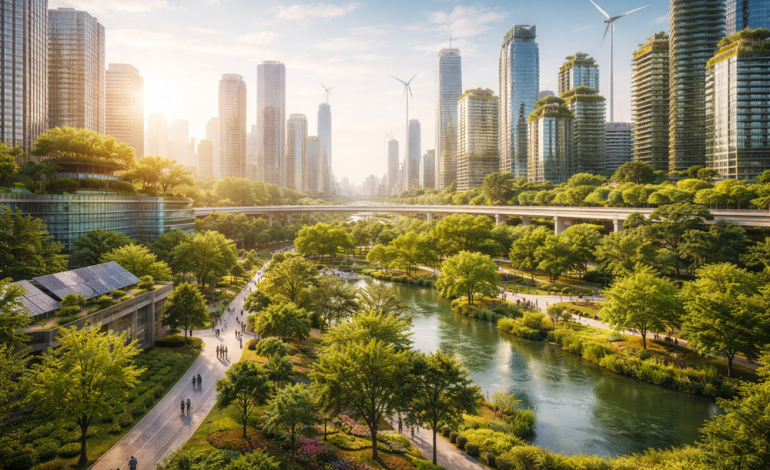
Urban green spaces are now recognised as vital climate infrastructure rather than aesthetic additions. Urban parks, tree-lined streets, shaded walkways, riverfronts, and community gardens collectively lower temperatures, reduce pollution, and enhance mental well‑being.
These green networks also build stronger communities. Pedestrian-friendly pathways, play zones, and shared activity spaces create opportunities for social interaction across demographics, reinforcing trust and cohesion—an often overlooked element of city resilience.
National guidelines from IGBC and global certifications like LEED are accelerating the shift toward environmentally conscious development. Indian green-certified buildings consistently demonstrate notable reductions in water and energy use, making the environmental and financial case for sustainability stronger than ever.
Technology: the accelerator of sustainable urban living
Digital infrastructure is transforming how cities operate and how people live. Smart homes equipped with energy-efficient lighting, AI-enabled climate control, occupancy sensors, and solar-ready rooftops are reducing emissions while improving comfort.
IoT-based monitoring systems can detect leaks, enhance security, and support predictive maintenance. Digital community platforms streamline facility management, visitor tracking, and service delivery. At the city level, integrated command centres, automated traffic management systems, and EV charging infrastructure signal a shift toward cleaner, more efficient mobility.
These technological shifts are not just conveniences—they strengthen the long-term economics of sustainability. Lower utility bills, reduced maintenance costs, rising demand for green-certified properties, and job creation across clean energy and technology sectors collectively enhance the value proposition of sustainable urbanisation.
Building cities for the next generation

India’s urban future depends not on rapid expansion but on intelligent expansion. The cities that succeed will be those designed as integrated ecosystems—where infrastructure, technology, and nature coexist and reinforce one another.
Water security, green infrastructure, energy efficiency, and digital systems are now prerequisites for resilient cities. Beyond environmental benefits, these measures foster community well‑being, economic competitiveness, and disaster resilience.
Sustainable urbanisation is ultimately an investment in generational stability. By embedding sustainability into every layer of urban planning, India can build future-ready cities that are equitable, liveable, and resilient—cities that do not just grow but grow responsibly.
Source link : View Article