As resources become scarce and environment becomes degraded, it is no longer a choice for companies to change their consumption patterns, but an economic necessity. For decades the global market has been based on a linear “take-make-waste” process, which entails taking raw materials, turning them into consumer products, using them for a short time, and ultimately discarding them. This linear path enables ecological destruction to accelerate, and causes businesses to face high volatility in their supply chains. In order to address this systemic issue, innovative companies are quick to follow the principles of a circular economy. A circular economy meaning, an economy that sees waste as a costly end product of production, rather than a normal by-product, and considers every by-product as a valuable resource for a new production process. This model focuses on both system-wide regeneration and the durability of assets, as well as superior material recovery, to break the link between the consumption of limited resources and the expansion of industry. As climate laws get stricter and international Extended Producer Responsibility (EPR) legislation requires full corporate responsibility, it’s essential for future-proof business models to embrace this circular approach. It calls for a total redesign of product design, process flows and logistics. Modern organisations can make a significant reduction in their carbon footprint, prevent harmful emissions, and create a robust, within-borders economic ecosystem, by closing material loops.
Introduction
Understanding the importance of the relationship between circular economy and sustainability strategies is a key element in the construction of a resilient and sustainable future. By examining the intersection between circular economy and sustainability, organizations discover that there is little overlap until they consider a circular economy of an industry that restores our ecosystems.Modern businesses can improve their operations by integrating a closed-loop system into their processes, which can help them to:
- Address Resource Volatility: Sourcing of high quality secondary raw materials from local source to reduce resource dependence from import.
- Meet Green Mandates: Easily meet strict regulatory standards for recycled content and carbon emissions.
- Foster Innovative Solutions through Redesign: Re-thinking product design to facilitate easy disassembly, component remanufacturing and safe material recovery.
What is a Circular Economy?
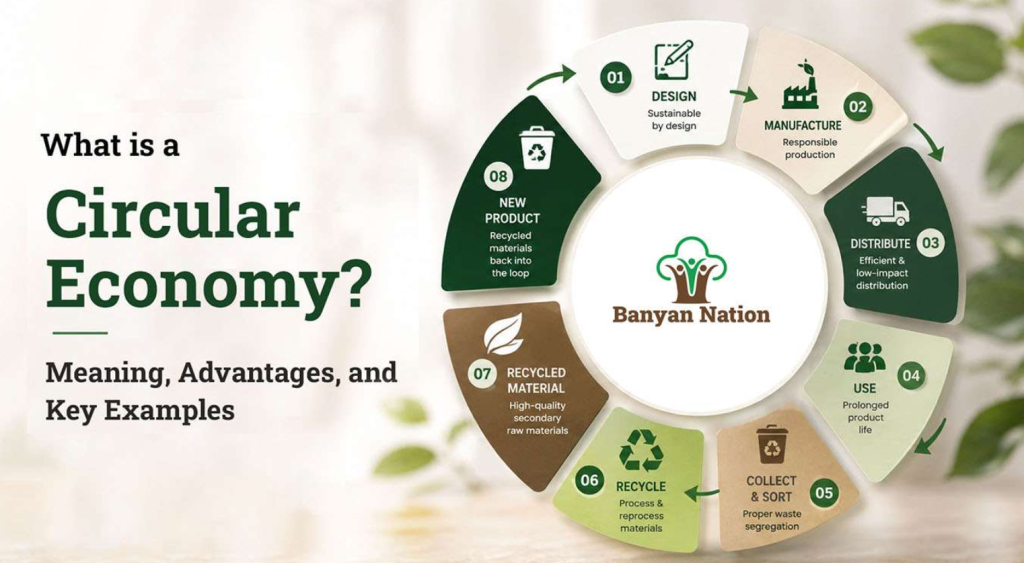
Moving towards the successful realization of circular economy and sustainability, it is crucial to understand the circular economy meaning in the framework of contemporary business systems. In a real sense, the circular economy meaning is an economic system that aims to reduce waste and pollution, keep products and materials in use for as long as possible and regenerate nature.
As one reads and examines what is circular economy, it is evident that this is not just a waste management program, but it is a totally different approach. To really understand what is circular economy, one must consider it as a systemic transformation of our overall industrial system, in which the culture of waste is being replaced by new material cycles, which are infinite and total.
The Three Core Principles of a Circular Economy
The three principles set out by the Ellen MacArthur Foundation are used in practice as a circular economy. These principles help businesses to move away from the wasteful linear business models and towards the truly restorative one.
- Eliminate Waste and Pollution: Products are designed to avoid the generation of waste and pollution at the conceptual stage so that materials aren’t ever regarded as waste.
- Move Products and Materials: Moving products, components, and raw materials through the economy at their highest value and utility whether in the form of industrial products or as safe biological nutrients.
- Restore Nature: Change human practices from extraction to healing and restoration – supporting natural carbon sinks and biodiversity.
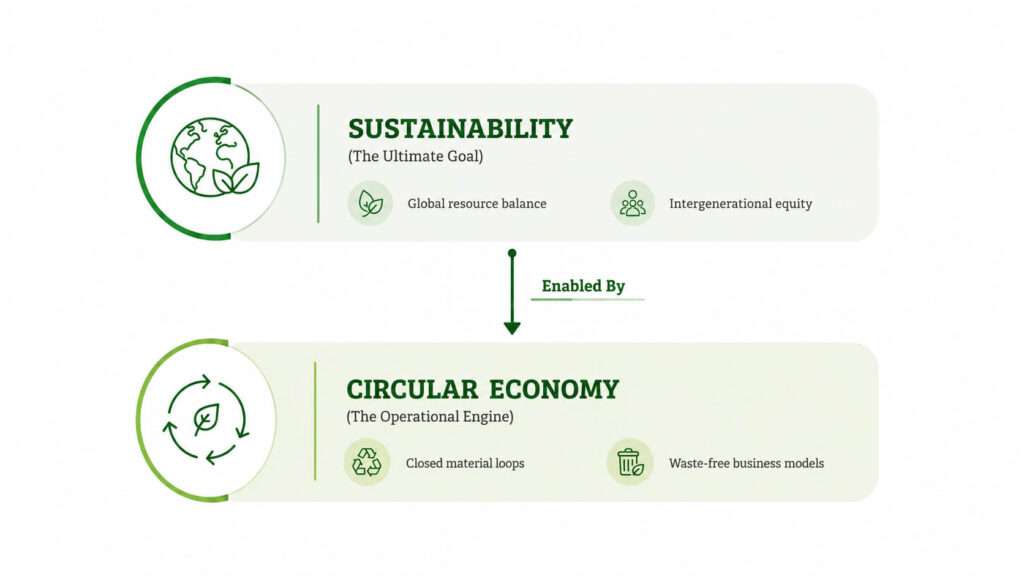
Circular Economy and Sustainability: How Do They Connect?
Although the terms are often used as synonyms, an examination of the nature ofwhat is circular economy shows that it is an influential and concrete toolkit that can bring about other environmental ambitions. This model gives the economic mechanics in explicit terms that are necessary to reach our ultimate long term environmental objectives of sustainability.
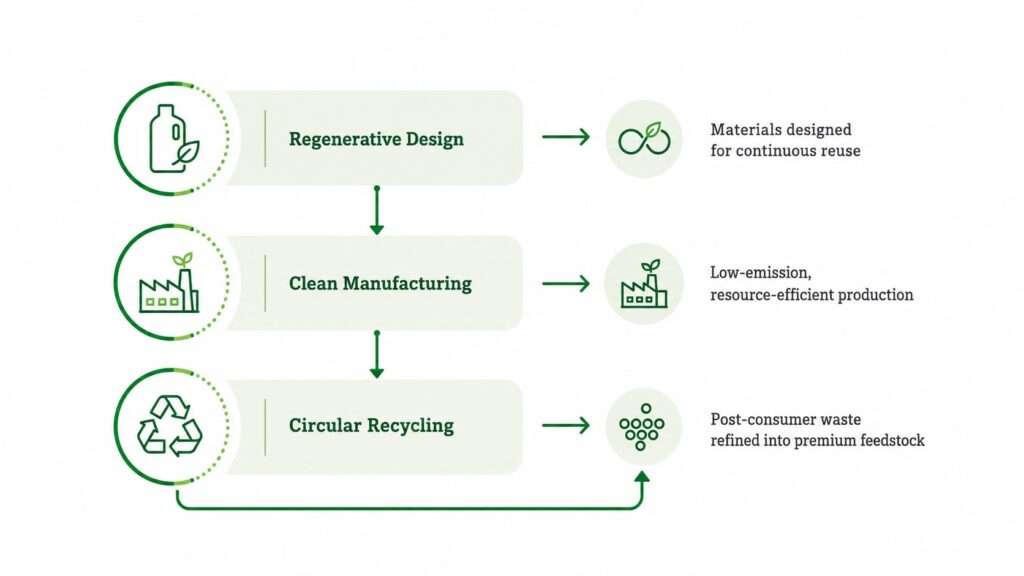
This allows companies to move beyond the rhetoric of becoming ‘eco-friendly’ and towards tangible, auditable reductions in Scope 1, 2 and 3 GHG emissions, by using high-purity circular recycling and replacing virgin extraction, which is carbon-intensive.
Key Advantages of a Circular Economy for Businesses and the Environment
Closed-loop solutions offer a tremendous opportunity to the circular economy that can be leveraged by businesses for bottom-line impact and the wider regional ecosystems. The above structural circular economy benefits demonstrate that environmental protection can be a positive force in achieving industrial profitability and market growth.
The systemic shift benefits include:
- Significant Cost Savings: Including the valuable components and resins into the internal production loop to reduce the raw material cost.
- Improved Supply Security: Ensure supply chain security when facing international resource scarcity and geopolitical shocks through local secondary materials.
- Drastic Landfill Diversion: Prevention of millions of tons of non-biodegradable waste from landfilling in local municipal dumpsites.
- Sustainable Energy: Reducing the amount of energy required in industry, since recycled materials require much less energy to be transformed into a useable product than raw earth or crude oil.
Real-World Circular Economy Examples
By applying these abstract principles to a specific case of a circular economy we can see circular economy examples incorporated in different markets worldwide. In the present scenario,circular economy examples are being implemented by the best global companies to reach absolute zero waste.
- The Electronics Sector: Tech manufacturers in place with strong device take-back initiatives which enable them to extract rare earth metals and microchips from old cellphones and use them to create new ones.
- The Commercial Apparel Industry: Fashion brands creating their clothes using uniform mono-material threads which can be broken down and spun again into high quality retail textiles.
- Heavy Automotive: Worn drives replaced and remanufactured to meet original factory performance specifications at 80% of the energy used in new production.
Closed-Loop Plastic Recycling: The Banyan Nation Model
We have a very strong, hyper-localized example plastic circular economy examples in action at Banyan Nation. Traditionally, plastics packaging was linear, and post-consumer resin was of poor quality and inconsistent purity, leading, as a result, to its ending up in landfills or oceans.
We have interrupted this linear decline by creating a data-driven collection system and making use of proprietary mechanical hot-wash and scientific decontamination processes. We collect post-consumer plastic waste and re-engineer it into Better Plastic™ high-purity near-virgin quality PCR resins; which can be used by global FMCG brands to create new packaging. The loop is clean and predictable, and an ideal example of the type of business asset that can be created out of an environmental crisis with ccircular economy companies.
The Critical Role of Circular Economy in Waste Management
The direct incorporation of closed-loop principles develops the traditional municipal disposal practice by focusing waste management processes of the circular economy around high purity resource recovery. While traditional waste management simply involves collecting and burying waste, a circular economy advantages are that the municipal waste streams are seen as valuable secondary mines.
For achieving efficient circular economy waste management and gain circular economy advantages, it is essential for municipalities and enterprises to adhere to strict source separation, optimize optical sorting technologies in material recovery facilities, and set up clear tracking networks. This infrastructure allows waste packaging to be successfully sorted out before it is contaminated, which maximises the economic value of the entire packaging waste recovery chain.
Conclusion: The Path Forward for a Circular Future
There is no other way forward than the transition towards a circular economy waste management as a modern society that lives on a finite planet. We can progressively root out the very notion of waste from our industrial systems, by breaking free from old linear practices and adopting increasingly sophisticated design and high purity recycling. They strengthen our environment, stabilize our resource supply chains and contribute to a sustainable future in which all materials serve a purpose and have a value.